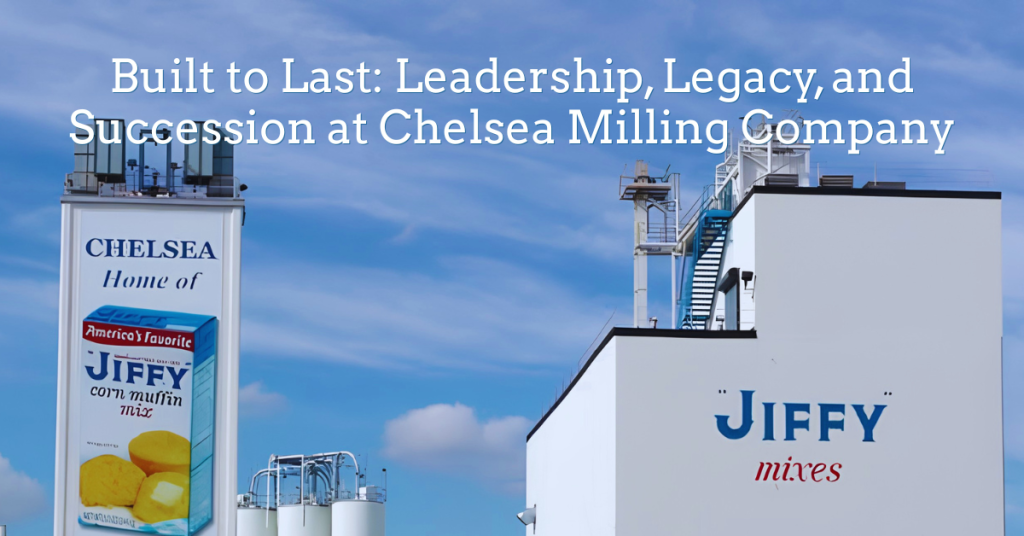
For more than a century, Chelsea Milling Company has been an enduring presence in American kitchens. Best known for its iconic Jiffy Mix products, the family-owned business has thrived across generations thanks in no small part to the unconventional leadership journey of Howard “Howdy” Holmes.
 Holmes’ story doesn’t follow the typical path of a family-business successor. From wandering the factory floor as a toddler to racing at the highest levels of motorsports and eventually returning to transform a 100-year-old company, his journey is defined by curiosity, resilience, and reinvention. Conway Center for Family Business sat down with Howard “Howdy” Holmes to reflect on his experience growing up in the business, stepping away to chase a dream, and ultimately returning to lead and transform a century-old company.
Company Origins & Early Life
The company itself dates back to 1872, when Howard’s great-grandfather moved from Dexter, Michigan and entered the milling business. By 1901, the family had full ownership and renamed it Chelsea Milling Company. In 1930 Howard’s grandmother created the first iteration of Jiffy Mix when a friend of her son came over with “hockey puck”-like biscuits for lunch that his single father had attempted to make. Inspired, she set to work making a biscuit mix that was so easy, it only required adding milk to make perfect biscuits every time. Howard Holmes grew up around Chelsea Milling Company, with some of his earliest memories of the business being wandering around the factory as a toddler on weekends. It was where dad went to work and where he got to see and spend time with him. Howard started working there himself, for the first time, as a sophomore in high school. From the outset, Howard’s father made one thing clear: start at the bottom.
“Why is everybody watching me and pretending that they’re not?” Howard remembers thinking in those early days. Howard remained focused on proving himself, navigating early moments of teasing and minor workplace antics. Looking back, Howard didn’t really know the expectations, but he’s not a coaster and knew those weren’t his values. It was an early exposure to what people do and don’t do, and why. Instead of retreating, Howard leaned in. It became a competition to outwork everyone. Sometimes he stumbled, but more often he proved himself.
The Racing Chapter
Howard Holmes grew up in a family where one of their shared traditions was attending the Indianapolis 500, first experiencing it in 1959. The experience left a lasting impression, sparking a fascination he didn’t fully understand at the time but knew he wanted to be part of. That interest reignited in 1967 when Michigan International Speedway opened, and he discovered a driving school led by Stirling Moss. Captivated, he dropped out of college, built a homemade trailer, bought a small single-seat race car, and dove in despite admitting he “had no more idea than a rabbit” what he was doing.
Not naturally a car expert, he became his own mechanic, learning through trial and error and persistence in an era with little available guidance. His parents neither pushed nor discouraged him. Howard was named the Indianapolis 500 Rookie of the Year in 1979. Ultimately, the experience taught him self-reliance, problem-solving, and determination: these lessons would later prove invaluable, making his eventual return to Chelsea Milling Company feel not only natural but well-prepared for.
Howard often describes racing and manufacturing as “twin sisters.” At first glance, they seem worlds apart, but at their core, they share some of the same principles, like needing to extract peak performance from equipment and the need for constant iteration and improvement. Howard also highlighted how both racing and working in the family business required problem-solving under pressure.
Return to Chelsea Milling Company
Howard returned to Chelsea Milling Company in 1987 and found a company that felt stagnant. Many employees saw him not as a leader, but as “the racecar driver.” He had to reinvent himself and earn their trust. Chelsea Milling Company now had 270 employees (today, it’s around 360), but there were no formal systems, no employee handbook, and little organizational structure. Racing is about the absence of emotion, but family business is full of it. He had to tap back into that. Howard Holmes took the time to reconnect with the employees, meeting with each of them and even engaging in focus groups and therapy to reconnect emotionally. Howard found a need for the right people with the right equipment. People get stuck in routines; getting them to pursue growth is difficult. Howard believed that if he could change, others could too.
Howard Holmes built his leadership philosophy around a simple but enduring principle: hire for character first, 70% personality and integrity, 30% skill. This is the formula he’s followed for more than 35 years while fostering a “business family” rooted in curiosity, collaboration, and continuous growth, even creating a personal development department to reinforce those values. As he helped transform the 100-year-old company, his biggest mindset shift was clear: everything could change except the culture, which he defined as how decisions are made and how people communicate, because it’s always grounded in respect, self-awareness, and a shared purpose of “feeding America.”
That same clarity extends to stewarding Jiffy Mix, where the commitment to high-quality ingredients at the best value has remained unwavering, supported by a no-advertising strategy that passes savings directly to consumers and lets loyal customers drive growth. Holmes embraced long-term thinking like expanding into food service in 2007 after careful, behind-the-scenes learning, planning workforce transitions years in advance, and never resorting to layoffs, while maintaining that reinvention starts with individuals. At the same time, he recognized the complexities of family business, separating emotion from decision-making by documenting discussions, creating space for objectivity, and relying on a board with more outsiders than insiders to ensure thoughtful, balanced governance.
The Future of Chelsea Milling Company
Howard’s desire for what people say about his leadership is that “he tried his best.” Continuing, “We judge ourselves by our intentions, others judge us by our actions, and they’re not the same thing.” Looking ahead, Howard Holmes is energized by knowing the right people are in the right roles, especially now that his son is serving as president. Howard remains actively engaged in the business without interfering, a balance that reflects a thoughtfully executed and remarkably smooth generational transition. Howard’s succession experience with his father was marked by tension, misalignment, and even headlines highlighting internal conflict often driven by differing views on growth and decision-making. Determined to break that cycle, Howard took a more intentional and involved approach with his own son, fostering alignment, trust, and a shared understanding of what it takes to lead, including the importance of profitability and staying competitive.
His perspective on succession is grounded in humility and realism. Leadership cannot be forced or compared, but must be earned and developed individually. In a world increasingly focused on speed and scale, Chelsea Milling Company stands as proof that longevity comes from something deeper: purpose, patience, and people. And in that sense, the Holmes family didn’t just build a company, they built something designed to last.
 Join Conway Center on May 21 2026 for a Family Business Spotlight with Jiffy Mix featuring Howard "Howdy" Holmes!